


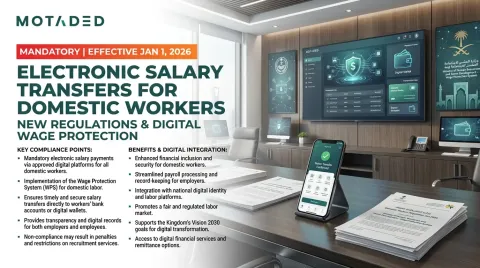
Launch of the Final Phase: Mandatory Electronic Transfer of Domestic Workers' Salaries in Saudi Arabia for 2026
The Ministry of Human Resources and Social Development (HRSD) has officially announced the commencement of the fifth and final phase of the decree mandating the electronic transfer of domestic workers' salaries, effective January 1, 2026. This date marks a significant milestone, as the mandate now applies to all employers across the Kingdom without exception, regardless of the number of workers they employ. At Motaded Ltd, we believe this development further solidifies the Kingdom’s position as a regulated and fair work environment embracing the latest digital solutions.
I. The Digital Transformation Journey: From Gradual Phases to Full Mandate
The decision for the electronic transfer of domestic workers' salaries 2026 was not accidental; it is the result of a deliberate strategy implemented by the Ministry throughout 2025 to ensure the readiness of the community and banking systems:
Phase Two (January 2025): Targeted employers with four or more workers.
Phase Three (July 2025): Included employers with three or more workers.
Phase Four (October 2025): Applied to those with two or more workers.
Phase Five (January 1, 2026): Full mandate for all employers, even those with a single domestic worker.
II. Objectives of the Decree and Impact on Contractual Transparency
The decree aims to regulate the contractual relationship and safeguard the rights of both parties. The Ministry of Human Resources emphasizes that this step contributes to:
Documentation of Wage Payments: Eliminating labor disputes related to delayed or unpaid salaries.
Enhancing Transparency: Creating a verified digital record for every financial transfer made through official channels.
Compliance with International Standards: Raising the Kingdom’s ranking in labor rights and financial transparency indices.
The Role of the "Musaned" Platform
The Musaned platform is the primary driver of this transformation. It links the employer with the worker and provides the necessary tools to complete transfers via banks and approved digital wallets (such as STC Pay, Urpay, and others).
III. Procedural Steps for Electronic Salary Transfer (A Practical Guide)
To ensure compliance and avoid regulatory violations, employers must follow these Ministry-defined steps:
1. Linking Core Data
The process begins by linking the domestic worker’s mobile number to their Residency ID (Iqama) via the "Absher" platform. This is essential for receiving financial notifications and digital identity verification.
2. Opening a Bank Account or Digital Wallet
The employer must assist the worker in opening a bank account or an approved digital wallet. Most Saudi banks now offer a "Domestic Worker Account" option, which is easy to open and does not require a minimum balance.
3. Using the "Salary Transfer" Feature in Banking Apps
On payday, the employer uses the specific "Domestic Worker Salary Transfer" option within their banking app. This is distinct from a regular transfer, as it is immediately recorded in the Ministry's systems as a "Verified Wage Payment."
IV. Benefits of Electronic Transfer for Employers and Workers
The electronic transfer of domestic workers' salaries 2026 provides tangible benefits beyond mere legal compliance:
Benefits for the Employer:
Legal Protection: Digital records are the only definitive evidence accepted by labor courts in case of claims of non-payment.
Streamlined Procedures: Facilitates the issuance of Exit-Reentry or Final Exit visas, as systems automatically verify that all salaries have been paid.
Electronic Authorization: The ability to authorize family members to execute transfers ensures payment continuity even if the employer is traveling.
Benefits for the Worker:
Financial Security: Guarantees that the salary is received on time and in full.
Easy International Remittance: Enables workers to send money to their families in their home countries with a single click at competitive exchange rates via digital wallets.
Financial Inclusion: Integrates workers into the banking system, making it easier for them to manage their savings.
V. Motaded Ltd’s Vision: Digital Transformation as a Pillar of Stability
At Motaded Ltd, we believe that digitalizing financial transactions is the first step toward building a sustainable economy. With our upcoming launch of the Motaded Digital Platform in mid-2026, we aim to provide integrated solutions that intersect with these government initiatives.
How Motaded Ltd Supports Digital Transformation?
Regulatory Consultancy: We assist investors interested in Saudi company incorporation in understanding modern labor and financial laws.
Compliance Management: Our future digital platform will offer tools for monitoring compliance and linking with ZATCA and GOSI systems to ensure all corporate and labor transfers follow regulations.
Legal Awareness: We strive to educate our clients about the latest updates from the Musaned platform and the Ministry of Human Resources to ensure a dispute-free work environment.
VI. Regulatory Penalties for Non-Compliance
The Ministry of Human Resources confirms that failure to comply with the electronic salary transfer decree may expose the employer to several consequences, including:
Financial Fines: Imposed for every month of delay or for every worker whose salary was not transferred electronically.
Suspension of Services: Employers may be barred from issuing new visas or transferring worker services.
Legal Disputes: Difficulty in proving wage payments in court, which may force the employer to pay the salary again if no bank proof is available.
VII. Frequently Asked Questions (FAQ) - Final Phase 2026
Q: Does the decree apply to workers who already have old bank accounts?
A: Yes, but the transfer must be made via the dedicated "Domestic Worker Salary" option in the banking app to ensure it is documented on the Musaned platform.
Q: What if the worker refuses to open a bank account?
A: Compliance is the employer's responsibility. The worker must be informed that this procedure protects their rights and allows them to transfer funds internationally easily.
Q: Are there fees for the transfer process?
A: Most banks and digital wallets provide this service for free or for a very nominal fee to encourage digital adoption.
Conclusion: Toward a Fairer and More Efficient Labor Market
The completion of the mandatory phases for the electronic transfer of domestic workers' salaries by January 1, 2026, is a clear message that the Kingdom is moving toward a global model of justice and digitalization. At Motaded Ltd, we are proud to keep pace with these developments and provide support to all our clients on their journey toward institutional excellence.
If you are an investor considering opening a company in Saudi Arabia, understanding these intricate details of workforce management will put you on the path to sustainable success.